BLFFD: Party Trivia
- 4.9
- Rating
- 50.00K
- Installs
- Free
- Price

 Analysis by App-foxy
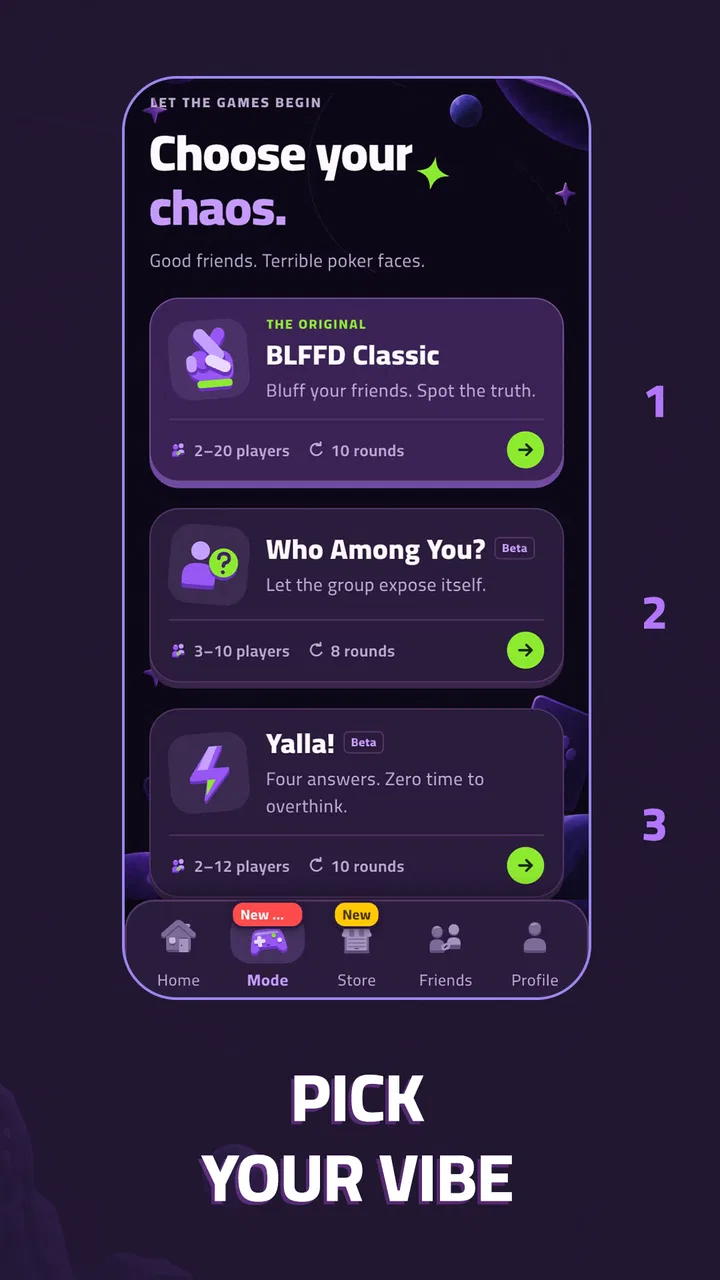
I approached BLFFD as a quick social trivia game rather than a traditional question bank. Its central idea is easy to understand: players create believable lies, look for the real answer, and try to outsmart their friends. That makes it a natural fit for a group that enjoys conversation, bluffing, and the small drama of watching someone defend an answer that may be completely invented.
The game comes from Piece of Web and is available as a free title for Android users. It is listed for Everyone, runs on Android 7.0 or later, and the current version is 1.3.5. The release date is Mar 17, 2026, so it is still a relatively new choice in the trivia space. I would not approach it as a polished replacement for every established party game, but I can see why a small group might want to keep it ready for a casual evening.
What interested me most was not simply whether the questions were difficult. A bluffing game lives or dies by how comfortably people can read the screen, enter an answer, follow the turn, and understand what is happening when several people are talking at once. For that reason, my experience with BLFFD is best judged through the practical situations in which people actually play it: sitting around a table, passing a phone between friends, playing remotely from different rooms, or trying to join when reading, movement, hearing, or attention may vary from person to person.
You May Also Like

 AccuWeather: Weather Radar
AccuWeather Review: A Quick, Clear Forecast for Everyday Decisions
For everyday plans, the best forecast is the one you can understand quickly. AccuWeather makes rain timing, radar, and local conditions easy to act on, with a few trade-offs.

 Hill Climb Racing
Why Hill Climb Racing Still Turns Crashes Into One More Run
A tiny car, a bumpy hill and one more upgrade: Hill Climb Racing keeps resurfacing because its simple chaos makes every near-miss feel personal.

 AliExpress - Shopping App
AliExpress Makes Global Shopping Feel Personal, but Shoppers Bear the Risk
AliExpress turns a global marketplace into a pocket-sized discovery engine. Its reach is useful, its shopping loop compelling, and its trade-offs easy to miss.

 Lords Mobile: Kingdom Wars
Lords Mobile Is a Kingdom-Building Routine, Not a Quick Match
A case-by-case verdict on the building, battles, device demands, and social commitments that make Lords Mobile rewarding for some players and exhausting for others.

 PDF Scanner app - TapScanner
TapScanner Makes Paperwork Easier to Capture, Check, and Share
TapScanner makes scanning with a phone feel less like a rescue operation and more like a dependable step in getting work done. Its capture tools are useful, though not flawless.

 Block Blast!
 Shows How Much a Puzzle Game Can Leave Out
A quiet grid game shows why puzzle players increasingly value instant clarity, repeatable skill and low-pressure play—and where the genre still needs to catch up.
More From Our News Desk
View All News


How readable and understandable is the game?
The strongest part of the concept is its immediate social clarity. You do not need to learn a complicated fictional world or memorize a long rulebook before starting. The basic rhythm is built around a question, a set of possible answers, and the challenge of separating a convincing lie from the truth. That is a useful design choice for a trivia game because new players can understand the objective through the first round instead of studying instructions for several minutes.
In my view, the simplicity also helps mixed-experience groups. Someone who rarely plays mobile games can still take part because the appeal is not based on reflexes, character upgrades, or a large collection of controls. The important skill is noticing which answer sounds plausible and deciding whether another player is trying too hard to sound certain. That gives the game a more conversational feel than a standard quiz where everyone simply taps the correct option.
There is an important distinction, though, between an easy concept and a fully accessible interface. A game can explain its rules clearly while still becoming tiring if text is dense, buttons are close together, or the active turn is easy to miss. I would therefore recommend starting with a quiet test round before inviting a large group. This lets everyone see how the question, answer entry, and result flow work without the pressure of a competitive match.
For players who read slowly, the bluffing format can be more forgiving than a fast reaction quiz, provided the group agrees not to rush. A useful house rule is to give everyone the same comfortable amount of time to read and compose an answer. That keeps the contest focused on cleverness rather than speed and prevents the quickest typist from gaining an accidental advantage.
Another practical tip is to keep the phone at a stable viewing angle rather than passing it rapidly from hand to hand. In a noisy room, people can miss whose turn it is or overlook a result while talking. Placing the device where everyone can see it may reduce that confusion, although it can also make private answer entry less comfortable. This is one of the central trade-offs of a social bluffing game: shared visibility improves group awareness, while individual privacy protects the surprise.
BLFFD is likely to work best when one person takes responsibility for keeping the pace calm. That person does not need to act as a formal host, but they can pause the conversation when someone is still reading, repeat the current instruction aloud, and make sure nobody is left behind. The game itself provides the activity; the group still supplies much of the accessibility.
Reading load and the bluffing advantage
The need to invent a lie adds a different kind of reading demand from ordinary trivia. A player is not only trying to understand the question but also deciding how much detail to include in a false answer. I found that short, specific lies are easier for a group to process than long explanations. They are quicker to type, easier to compare, and less likely to create a confusing wall of text.
This is a useful strategy for anyone who finds extended writing tiring. Instead of trying to produce a clever paragraph, answer with one precise idea that sounds possible. The challenge then becomes judgment and timing rather than typing endurance. It also makes the game fairer for players who use a phone keyboard less comfortably.
At the same time, players who depend on larger text, stronger contrast, screen magnification, or a screen reader should check how the game behaves on their device before planning a full event. I would not assume that a trivia interface automatically handles every Android display setting well. The safest approach is to install it early, open a practice round, and confirm that the question and answer areas remain understandable with the settings each person needs.
Motor, sensory, and attention considerations
BLFFD does not appear to rely on the kind of rapid physical action associated with arcade or action games. That is a meaningful advantage for players who prefer slower input or who find repeated fast tapping uncomfortable. The main physical tasks should be reading, selecting, and entering an answer, so the game may fit a relaxed sitting position better than a reflex-based alternative.
Still, “not action-heavy” does not mean effortless for every player. Writing a convincing lie can require several taps, corrections, and decisions on a small touchscreen. If someone has limited fine-motor control, a stylus, a larger device, voice input, or a trusted helper could make participation easier, depending on the device setup. Voice input may be useful for drafting an answer, but I would treat it as a practical workaround rather than assume the game has been designed around it.
There is also a social issue around helpers. If another person enters an answer on someone’s behalf, they should not influence the wording or reveal the player’s intention. The fairest arrangement is for the player to dictate exactly what to enter, with the helper acting only as a typist. That preserves the central bluffing skill and avoids turning physical assistance into an accidental strategic advantage.
For people sensitive to sound, the best setting may be a quieter room with the device volume kept low or muted if the game remains understandable without audio. I would not make loud group commentary part of the rules. Friends often react loudly when a lie fools everyone, but that excitement can make it difficult for someone with hearing differences, auditory processing challenges, or concentration needs to follow the next prompt.
Visual attention can be affected by the same problem. When several players discuss an answer at once, the important information on the screen competes with faces, gestures, and conversation. A simple routine helps: read the prompt silently first, allow each person to submit, then discuss the options, and only after that reveal the result. This separates the reading stage from the social stage and gives players more control over where they focus.
People who tire quickly may appreciate shorter sessions built from a few rounds rather than an open-ended marathon. The free price makes it easy to try without committing money, but it does not remove the mental work of reading, inventing, comparing, and remembering. In my experience, the game is more enjoyable when the group stops while everyone is still engaged instead of stretching the session until answers become random.
A fairer way to include different playing styles
One non-obvious strength of this format is that the group can adjust the social rules without changing the core idea. If a player needs extra time, the whole group can use a shared time limit that is generous enough for everyone. If typing is difficult, answers can be shorter. If public reading is uncomfortable, one person can read the options aloud without commenting on which seems most convincing.
These adjustments matter because bluffing games can unintentionally reward confidence, speed, and performance more than knowledge. A quiet player may create an excellent lie but lose attention when louder friends debate it. I recommend asking everyone to read or present answers in the same order and giving each option equal consideration. That makes the game less dependent on volume and more dependent on the answer itself.
For players who struggle with open-ended choices, the group can agree that an answer does not need to be funny or elaborate. A direct response is valid if it sounds plausible. This lowers the creative barrier and keeps the game from becoming a contest among the most theatrical people in the room.
Using it in real situations
A realistic use case is a small gathering where conversation has started to slow down. Instead of asking everyone to learn a complicated party game, one person can introduce BLFFD and run a low-pressure round. The game gives the group a shared subject immediately, while the lies create stories and arguments that continue beyond the screen. This is where I think it has more personality than a conventional trivia app that simply announces right and wrong answers.
It can also work during a family evening if the adults explain the bluffing idea clearly and keep the questions comfortable for the people present. Because the content rating is Everyone, it is positioned for a broad audience, but the practical suitability still depends on the group’s humor, reading ability, and willingness to let younger or slower players participate at their own pace. An age label is not a substitute for choosing a friendly setting.
For a remote group, the experience depends more heavily on the call or chat being used alongside the game. Players may need to coordinate who is submitting, when discussion begins, and how answers are kept private. That extra coordination is not necessarily a flaw, but it means BLFFD is not automatically a complete remote-event solution. If your priority is a highly structured online party with built-in communication, another option may be more convenient.
The same point applies to classrooms, clubs, and accessibility-focused events. The game could provide a lively prompt for discussion, but an organizer should test it first and prepare a backup method for anyone who cannot comfortably use the interface. For example, a participant might give an answer verbally while a partner enters it, or the organizer might display the prompt and collect responses in another way. The important thing is to preserve equal opportunity to deceive and judge.
On a train, in a waiting room, or during a short break, I would be more cautious. Social trivia needs enough attention for players to read and respond, and a public environment may make private answers awkward. Passing one phone around can also be inconvenient when people are standing or when the surroundings are crowded. BLFFD is better suited to a stable group with a little time than to a hurried solo session.
Who will enjoy the format?
I would recommend it to friends who like trivia but want more interaction than a standard quiz provides. It is especially appealing when the group enjoys guessing personalities: who gives too much detail, who sounds suspiciously confident, and who can make an ordinary lie seem authentic. The entertainment comes from those observations as much as from knowing facts.
It is less suitable for someone looking for a solo knowledge workout. The store summary centers on friends, and the design idea depends on other people supplying believable false answers. If you usually play on your own, a conventional trivia app with a large question library, progress tracking, or timed solo challenges may offer more lasting value.
It may also disappoint players who want deep control over categories, difficulty, or competitive progression. I would not choose it for a formal tournament unless I had first tested the complete flow with the intended number of participants. A game based on social deception needs consistent turn handling and clear results; any uncertainty there becomes more noticeable when the group is large.
What still creates barriers?
The biggest remaining barrier is that accessibility is shared between the app and the people using it. Even a readable prompt can become difficult when friends interrupt, reveal clues, or pressure someone to answer quickly. A considerate group can solve much of that, but a player should not have to rely entirely on perfect social behavior to participate.
Another barrier is the tension between privacy and visibility. Players need to enter lies without others seeing them, yet the group needs to know what stage the round has reached. On a single phone, those goals compete. A player with limited reach, vision, or confidence handling a device may need more time to position it correctly. A larger screen could help readability while making private entry harder in a shared setting.
Typing is also a meaningful limitation. The game’s premise asks players to create answers, so it cannot be treated like a quiz where tapping one of four choices is enough. Anyone who dislikes mobile typing may find the core activity more tiring than expected. Keeping answers concise helps, but it does not remove the need to compose text.
Attention differences can affect the social deduction side as well. Remembering several answers and comparing their wording may be harder than simply selecting a known fact. A helpful group can read options aloud one at a time and allow a pause before voting or judging. That approach may slightly slow the game, but it produces better decisions and makes the contest less dependent on quick memory.
I would also avoid assuming that the newest version solves every practical concern. Version 1.3.5 is the current release, and the game has attracted over ten thousand installs, but those figures do not tell me how well every device configuration handles text size, input methods, audio, or screen readers. The sensible review habit is to test the exact phone and settings that matter to you instead of treating general availability as proof of universal access.
The average rating is currently zero, which is not enough on its own to judge the quality of a new social game. I would read that figure as a reason to try a small session rather than as a clear recommendation or warning. The concept is promising, but its real value depends on whether your group enjoys making and evaluating lies more than it enjoys ordinary question-and-answer trivia.
My inclusive verdict
BLFFD has a focused idea and a useful social twist. By asking players to create believable false answers instead of merely recalling facts, it turns trivia into a conversation game. I like that it can involve people who are not especially competitive gamers, and I appreciate that the main challenge is judgment rather than rapid movement.
Its inclusive potential is strongest in calm, cooperative groups that are willing to adjust the pace. Short answers, a stable device position, spoken clarification, equal turns, and a quiet environment can make a noticeable difference. Those are not cosmetic changes; they directly affect whether a player can read, enter, and evaluate answers on equal terms.
I would skip it if you need a fully solo experience, a tightly managed remote platform, or a game built around advanced accessibility controls. I would also hesitate to use it with a large group before testing the flow, because a single shared phone can create privacy, visibility, and turn-taking problems. In those situations, a more structured trivia alternative may be the better choice.
For a few friends sitting together, however, the free entry point makes experimentation easy. Install it on a compatible Android device, try one unrushed round, and pay attention not just to whether the questions are fun but to whether every player can comfortably follow the screen and contribute a lie. My final opinion is cautiously positive: the best experience comes from treating accessibility as part of the group’s rules, not as an afterthought.
Piece of Web has created a trivia game with a clear reason to talk, argue, and laugh. It is not automatically accessible in every context, and it should not be presented as a universal fit. But when the setting is suitable and the group makes room for different reading, typing, hearing, movement, and attention needs, BLFFD can become a welcoming alternative to the usual trivia format rather than just another collection of questions.
FAQs for BLFFD: Party Trivia
01What is BLFFD and what does it offer?
BLFFD is a dynamic social networking app that connects users through shared interests and hobbies. It offers features like group chats, event planning, and personalized recommendations to enhance social interactions. Users can join various communities based on their preferences and engage with like-minded individuals.
02Is BLFFD available for both Android and iOS devices?
Yes, BLFFD is available for download on both Android and iOS platforms. Users can find it on the Google Play Store and Apple App Store. The app is designed to provide a seamless experience across different devices, ensuring accessibility for all users.
03How secure is my personal information on BLFFD?
BLFFD prioritizes user privacy and security by implementing robust encryption and data protection measures. The app requires minimal personal information for registration and offers customizable privacy settings, allowing users to control who can view their profiles and posts. Regular updates are conducted to enhance security features.
04Are there any in-app purchases or subscriptions in BLFFD?
BLFFD offers a free version with essential features available to all users. However, there are optional in-app purchases and subscription plans that provide access to premium features, such as advanced customization options and ad-free usage. These purchases are entirely voluntary and not required for basic functionality.
05How can I resolve technical issues or get support for BLFFD?
For any technical issues or support queries, BLFFD provides a comprehensive help center within the app. Users can access FAQs, troubleshooting guides, and contact customer support via email or chat. The support team is responsive and committed to resolving issues promptly to enhance user experience.
Pros
- User-friendly interface with intuitive navigation.
- Extensive customization options available.
- Seamless integration with other apps.
- Regular updates with new features.
- Efficient customer support response time.
Cons
- Occasional glitches affect performance.
- Requires significant storage space.
- In-app purchases can be costly.
- Some features locked behind paywall.
- Battery consumption is relatively high.

BLFFD: Party Trivia
Gallery